My Macaron Method

Fruity Pebble Macarons

Oh, I just love these airy little confections—and mastering them has been one of my proudest baking accomplishments.

Macarons can seem intimidating, but they're more about technique than difficulty. Once you understand the key principles and tricks for success, you too can master them in your own kitchen.

I spent considerable time reading recipes, calculating ratios, and sifting through the commentary and strong opinions of other bakers. After experimenting on my own and trying numerous variations, some advice proved essential, while other ‘rules’ turned out to be surprisingly flexible.

Every baker's macaron journey is unique—success comes from understanding your technique, your oven, and even your local weather to achieve consistent results. After oodles of batches, I've landed on the below method, but I encourage you to experiment and discover what works best in your kitchen!

Take a peek at my Macaron Pinterest Board for inspiration and ideas!

Emoji Macarons

Ingredients:

  • 140g Almond Flour

  • 140g Icing Sugar

    ~~~~~

  • 115g Egg Whites (from ~4 eggs)

  • 115g Caster Sugar

  • 1/2 tsp Cream of Tartar

My Process:

  1. Set eggs aside for 1-2 hours before making meringue.

  2. Prepare baking sheets with a silicon mat and pre-heat oven to 300 degrees.

  3. Sift almond flour and icing sugar together twice and set aside.

  4. Whip egg whites in mixer until bubbles form, then add cream of tartar. Slowly add in caster sugar until mixed and let mixer whip until meringue forms. (This can take 5-7 minutes).

  5. Gently fold dry ingredients into meringue. I fold in half at a time, careful not to over mix or it will deflate the air from the meringue. I use the ‘figure eight’ test to determine when the perfect consistency is achieved.

  6. Add your macaron shell batter to a piping bag with a wide circular tip.

  7. Pipe batter onto prepared sheet pans.

  8. Tap trays and pop air bubbles to remove excess air.

  9. Let trays rest for approx. 20-30 minutes until a skin has formed on the shells.

  10. Bake at 300, one tray at a time. 7 minutes. Rotate tray. Another 5 minutes. Then remove tray.

  11. Let the shells cool completely on the trays. Any attempt to remove before they are cool will leave some of the shell stuck to the silicon mat.

  12. Assemble shells with desired fillings and decoration.

Lemon Lime Macarons

My Tips & Tricks:

  1. MEASURE BY WEIGHT - Invest in a quality food scale and weigh all of your ingredients. Macarons are delicate, and precision in your ratios makes all the difference between success and frustration.

  2. SIFT TWICE - Sift your dry ingredients together at least twice. Almond flour is coarse, and if you want smooth macarons that don't look grainy, this step is essential. When I'm infusing other dry ingredients (like fruity pebbles or cocoa), I pulse them in the food processor before weighing, then sift everything together with the almond flour and icing sugar for even distribution.

  3. NO PLASTIC - Use only metal bowls and tools. I discovered plastic can harbor tiny oil residues that will absolutely ruin your meringue. I now use only metal, sometimes glass, and even use a stainless steel spatula when folding dry ingredients into the meringue. This single change transformed the integrity of my meringue and my success rate.

  4. EGG WHITES - I leave eggs out a few hours before whipping. If I'm short on time, I'll set the container in a bowl of warm water to gently warm them to 70-75°F. I whip them in my stainless KitchenAid bowl until foamy, then add a pinch of cream of tartar for stability. Some recipes call for other types of sugar, but I've found that slowly adding superfine sugar (aka caster sugar) yields the most angelic meringue.

  5. COLOR - Add gel food coloring to the meringue if coloring the entire batch. For multiple colors, divide your batter slightly under-mixed, then add color to each portion as you fold to the proper consistency. If you wait until figure eight is achieved and then add color, it will be over-mixed.

  6. FLIP YOUR TRAYS - Turn your sheet trays upside down so the lip is on the bottom. The raised edges can create uneven heat distribution, causing shells around the perimeter to brown, crack, or develop inconsistent feet. This one flip solved several issues for me!

  7. AIR BUBBLES - Firmly slap your trays down on the counter and/or rap the trays from underneath to release trapped air bubbles that could otherwise crack your shells during baking. I also spend a couple of minutes hovering over my trays with a toothpick to pop any remaining bubbles before the shells start to set.

  8. RESTING - I let my shells rest for 20-30 minutes before baking. This allows the outer surface to form a skin, which encourages air in the batter to escape through the bottom edge (creating those glorious little feet!) instead of through the top, which causes cracks.

  9. ONE TRAY AT A TIME - There can be only one tray in the oven at a time—seriously! Multiple trays disrupt heat circulation, causing uneven rising, lopsided shells, and inconsistent results. Don't rush this step.

  10. COOL COMPLETELY - Let your shells cool completely on the tray before you attempt to remove them. If you find sticky bottoms, they might not be fully cooled yet. Alternatively, they could be under-baked—it's okay to return them to the oven for a few extra minutes to dry out. But even after extra baking time, let them cool completely before moving.

Circus Animal Cookie Macarons
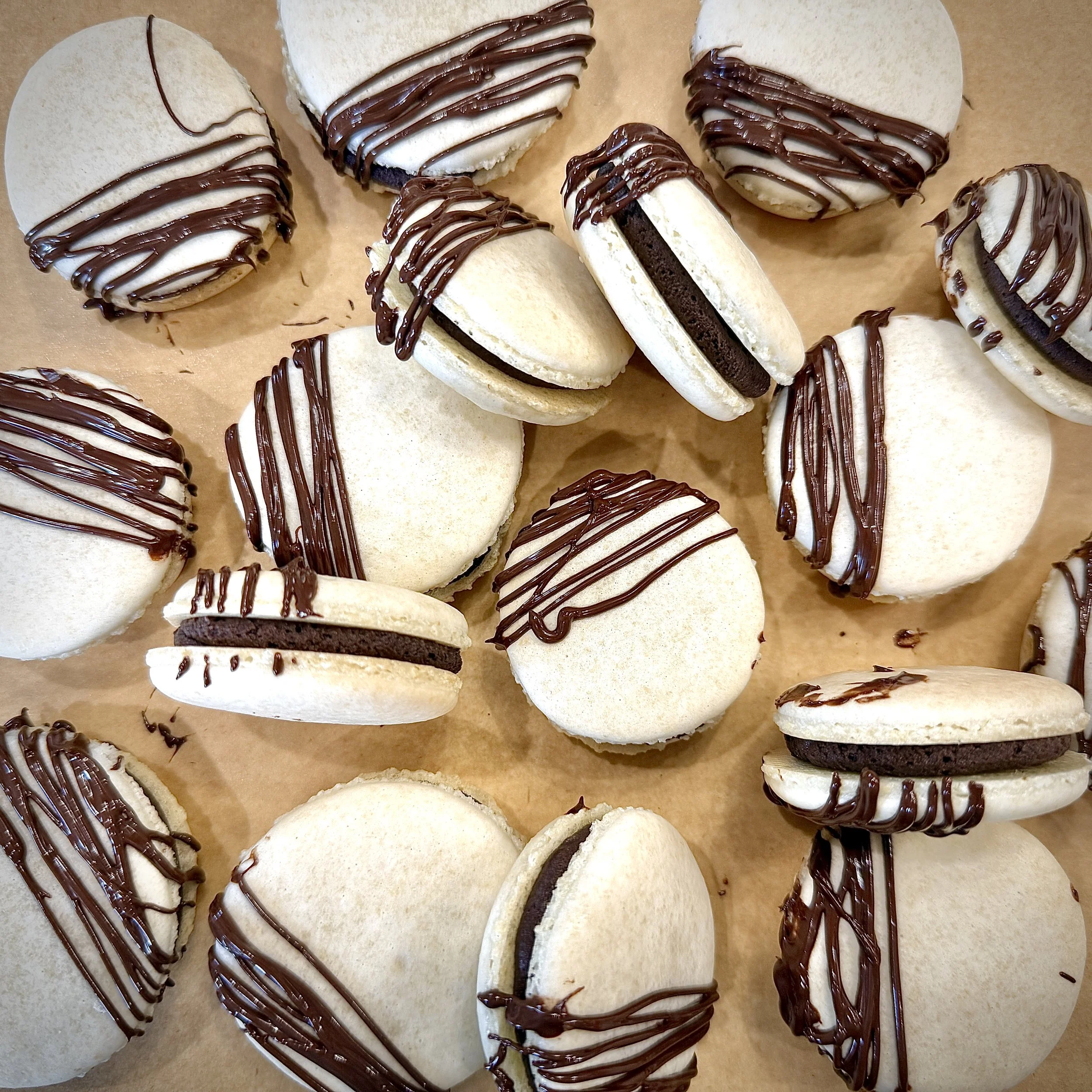
Chocolate Cream Macarons

Flavors I’ve made:

  • Classic Vanilla

  • Chocolate Cream

  • Chocolate Peppermint

  • Vanilla Bean

  • S’mores

  • Fruity Pebbles

  • Lemon-Lime

  • Circus Animal Cookie

  • Lucky Charms

  • Honey

  • Peppermint

  • Hot Cinnamon

  • Peanut Butter & Jelly

Flavors I’m still developing:

  • Blueberry

  • Toasted Coconut

  • Chocolate Orange


Vested Pinterest

Since I began decorating, I’ve been saving cake photos to serve as inspiration for (possible) future projects. There are so many talented cake artists out there who have shared their fun or unique cake photos — I just love ‘em! All of my cakes start with a design sketch. And I love having a trusted bundle of ideas at my fingertips when I sit down to design a new project.

Prior to 2010, I would [laboriously] save cake ideas and photos on my own computer in numerous folders by theme. But just after Pinterest kicked off, I began using it instead to save cake ideas. Now over a decade later I still visit Pinterest as part of a nighttime relaxation ritual, adding ideas to my boards I think might come in handy for a future project. You never know when you’ll need ideas for a pirate ship cake taking down a kraken! Or ideas for a unicorn cake flying through space!

I have over 100 boards on Pinterest devoted to cake, broken out by theme! That’s right. A board just for Star Wars cake ideas. A board just for Halloween cake ideas. And a board just for… you get it. I’m not sure how it happened, but my Pinterest account has over 5k followers. I think folks love my idea boards almost as much as I do!

Here’s just a sample of the OVER 100 cake themed boards I have on Pinterest, organized by theme:

I also use my Pinterest boards to point friends and family to who might need help narrowing down the scope of their cake request. : ) It’s a much nicer experience than saying “um, can you do a wide and non-specific search for cactus cakes and tell me what you like?” If I can point them to a board with nothing but cactus cake ideas I’ve curated over the years, I call that a win-win!


Whisk Taker

Do you know what the difference is between an experienced and inexperienced cake artist? Other than the obvious [experience], it’s really just one thing… An experienced cake artist knows how to cover their mistakes. We still make them. After nearly 20 years of decorating, I still make mistakes, sometimes blunders. But what my experience has truly taught me is (1) yes, how to make fewer mistakes, but more importantly (2) how to cover them up.

I learn something new with every cake I make. As a custom cake artist, no two cakes I make are the same. Every design is unique and I usually try new techniques or variations on something I may have done before. It can be risky, to not always rely on your stand-by routine for a project, but it’s how I learn. And I can usually count on my experience to cover up mishaps when my risks don’t pay off.

Some of my biggest and proudest cake knowledge wins came from taking risks:

  1. Using my culinary blow torch to melt buttercream atop a pizza cake. I could have burned the whole thing up, but it worked beautifully and the result looked just like melted cheese!

  2. Airbrushing right over krispy treats in the reef of my elevated shark cake. I had no idea what it would look like, but the result was amazing and it looked just like reef rock!

pizza2.jpg
shark7.jpg

Don’t be afraid to take risks. Push your skills, try new techniques. The worst that can happen is you will have learned something new and still have a yummy cake to eat while you reflect on what went awry or what to do differently next time around.


Rainbow Bueno

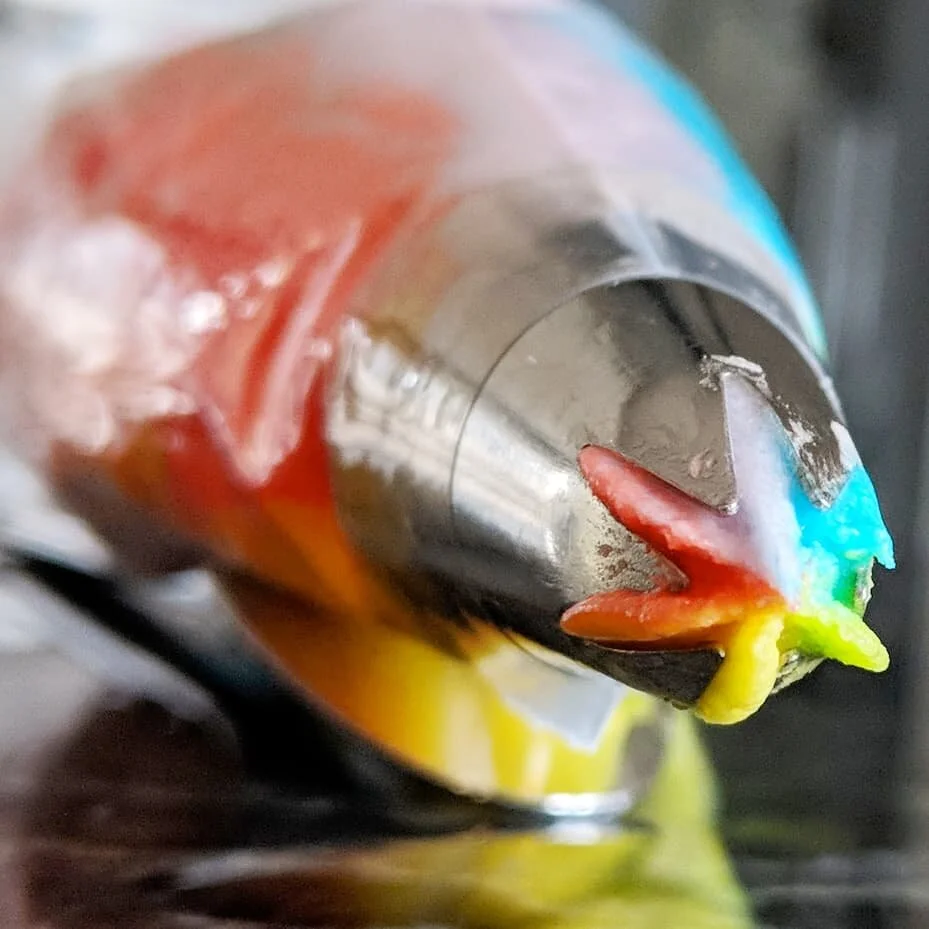
Is there anything more cheerful and wondrous than rainbow frosting?!? For reals. I don’t care how bad a day you might be having - if someone hands you a rainbow cupcake, you’re gonna smile. Well, at least on the inside.

For me, the most time consuming part of rainbow cupcakes is simply separating the buttercream and coloring each batch. But it’s so worth it. Every time I make rainbow cupcakes, I have the best time choosing just which shades to use and assembling the piping bag. I can’t help but smile swirling big rainbows on top of each cupcake, knowing how they light up everyone’s faces and moods when they see ‘em.

This is also a great opportunity for kiddos to help in the kitchen — who wouldn’t want to whip up rainbows?!

rainbow_piping.jpg
rainbow_colors.jpg
rainbow_cupcakes.jpg
 

Gathering Dust

I LOVE my collection of dusts… they make cakes ah-mazing! I paint with dusts on parts of nearly every cake I make to add dimension, depth or shine. There are a few varieties of dusts, each with different properties that will produce different effects. These are the different dusts I use (and did I mention LOVE):

  • Luster dust comes in many different colors and adds sparkle, shine, and a little color tint. You can brush it on dry or dilute with a little vodka to smoothly paint on. The vodka dries clear, leaving you with shimmery awesomeness.

  • Petal dust has a matte finish and is often used to decorate gum paste flowers because the matte appearance yields a natural look. But I mostly use petal dust to add shadow, aging and color depth. Sometimes I will air brush over it for deeper results.

  • Pearl dust leaves a sparkly, pearlescent finish with just a touch of color. I use it much the same way I use luster dust, but it’s a bit more translucent and leaves less color behind.

  • Disco dust is pretty much edible glitter, rather than powder. It packs a huge sparkle punch! Use it anytime you want your cake to really SPARKLE!

Behold! My dust collection.

I suppose you could buy these over the internet. But I buy mine at my local cake store and just love handling all the little jars, admiring the different sheens. For a special project, I highly recommend seeing them in person. Add a few tiny paint brushes and have some fun!

Tip: When painting leaves or flowers, I use several shades of the same color family. It adds so much more depth!

dusts.jpg
I sculpted this sorting hat from modeling chocolate. Just look at the before & after and the difference a little black petal dust made!

I sculpted this sorting hat from modeling chocolate. Just look at the before & after and the difference a little black petal dust made!

If the hat wasn’t enough to convince you, just look at these petals! Once the petals set overnight, I painted them with dusts the next day. Voila!

If the hat wasn’t enough to convince you, just look at these petals! Once the petals set overnight, I painted them with dusts the next day. Boom!


Color Me Happy

Oh, I just love color! I use AmeriColor products exclusively for coloring icing or batter, airbrushing and food-safe markers. I used other brands when I was getting started, but once I discovered AmeriColor, I was hooked forever. I purchase all of these products at my local cake store and even keep spares of colors I use more frequently — you never want to run out in the middle of an important project. When using colors, a little goes a long way. I start with just a little and test the result. You can always add more and deepen the color, but you usually can’t take color away.

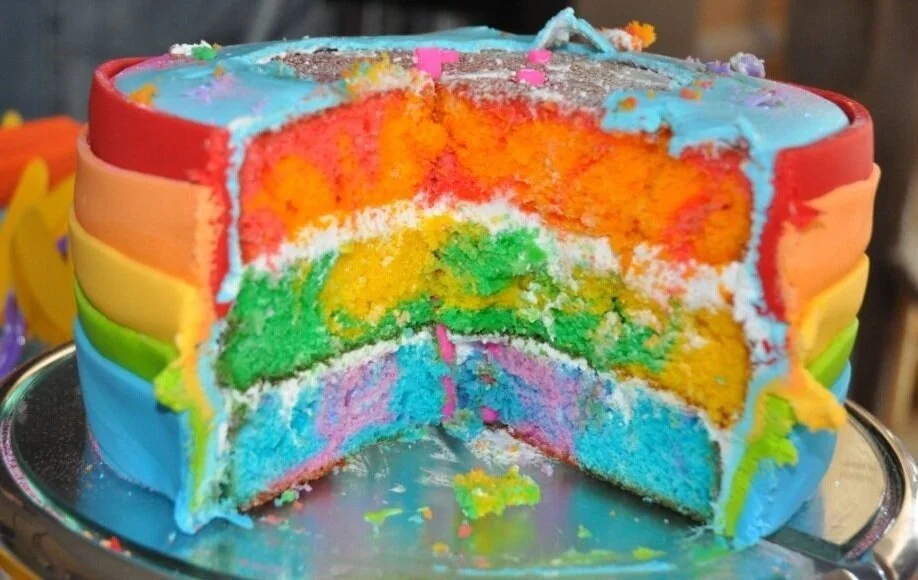
For me, a cake design caries all the way through to its core. I often put extra effort into a visual surprise when the cake is cut. Alternating colors or flavors, coloring white cake batter, using colored buttercream, adding sprinkles to the filling — there are so many ways to have fun!

Tip: I strongly recommend investing in a high-quality cake leveler. It makes a huge difference keeping your tiers even, level and smooth.

gpig4.jpg
hemione_layers.jpg
IMG_20200711_190941_154.jpg
americolors.jpg
sarah5_3.jpg
slime2.jpg
 

Sweet Redesign

Introducing v3! I built my first cake website from scratch nearly 15 years ago and it served me well for 7 years until I built v2 in Wordpress in 2012 (pictured below). Now after nearly another decade, I have rebuilt my site using Squarespace. Now that it’s January 2020, I figured this would be a sweet way to start the new year!